Programming Clojure, Fourth Edition (Pragmatic Bookshelf)

PragmaticBookshelf
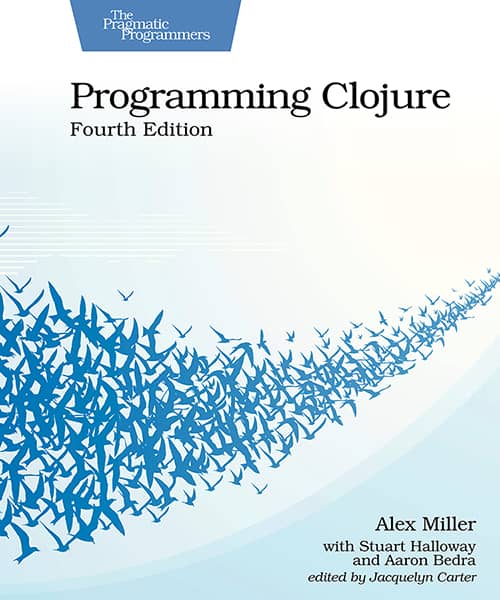
Alex Miller @alexmiller with Stuart Halloway and Aaron Bedra
Edited by Jacquelyn Carter @jkcarter
Struggling with unnecessary complexity, unmanaged state, and brittle data that’s hard to change? Clojure combines the expressiveness of Lisp with the stability and performance of Java into a practical toolkit for creating simple, extensible applications. With immutable data structures, functional programming, and safe concurrency, Clojure makes it easier to write robust, reusable code. This definitive guide, written by members of the Clojure core team, introduces the language’s essentials and then shows how to put everything together in real applications. This edition adds practical coverage of project tooling and interactive development and fresh examples of the latest Clojure features.
Build cleaner, more reliable software that can respond to changing requirements over time. Combine Clojure’s tools for maximum effectiveness as you work with immutable data, functional programming, and safe concurrency to write programs that solve real-world problems.
Start by getting comfortable with Clojure’s concise syntax and its interactive REPL, then quickly move into building with immutable collections and the powerful sequence abstraction. Gain practical fluency with functional techniques such as higher-order functions, recursion, partial application, and memoization. Beyond the basics, learn to manage state with Clojure’s reference types, build open and extensible systems using protocols and multimethods, and unlock the power of macros for creating your own language features. Seamless Java interop lets you tap into the vast Java ecosystem without sacrificing clarity or safety.
This edition adds two new chapters on project tooling and interactive development, guiding you through modern workflows with tests, builds, editors, and the REPL at the center of your process. Learn how to set up projects, manage dependencies, and work productively in Clojure’s unique interactive style. When you’re finished, you’ll be able to think in Clojure: express solutions with clarity, leverage concurrency safely, and build real-world applications that are simpler and more maintainable than you thought possible.
Alex Miller has been a member of the Clojure core team since 2013 and is the coauthor of Clojure Brain Teasers and Clojure Applied. Alex is the creator or organizer of the Strange Loop, Lambda Jam, Clojure/west, and Clojure/conj conferences. In his free time he dabbles in music production, astronomy, and beekeeping.
- Full details: Programming Clojure, Fourth Edition by Alex Miller
- View this book’s portal and details on how to post errata and suggestions here.
Don’t forget you can get 35% off with your Devtalk discount! Just use the coupon code “devtalk.com" at checkout 
Latest Threads About This Book









Most Active This Week
Most Active This Month
Most Active This Year
Most Active Last Three Years
Most Active Over Three Years
Latest in Programming Clojure, Fourth Edition
Get money off!

The Pragmatic Bookshelf
35% off any eBook
Use the coupon code "devtalk.com" to get 35% off any eBook published by PragProg!
Filter by Type:
Related Portals
Devtalk Sponsors

Practical resources that improve the lives of professional developers.

We build trusted fault-tolerant systems that scale to billions of users.

Real-time error tracking, performance insights, and observability for devs.

Supporting innovation across the BEAM ecosystem.

We build reliable cloud platforms for business-critical systems.

Develop your skills with books, videos, and courses.

Catch errors, track performance, monitor hosts and more.

Enabling companies to succeed by building software people love.

Courses that move you from confusion to "Aha, now I get it!"

Publishing Linux Magazine, ADMIN, and MakerSpace for 25+ years.